
The Gilmer County Court Calendar
The Appalachian Judicial Circuit posts a page called Judicial Calendar and Hearing Dates. It offers printable 2026 calendars for Superior and Juvenile Court. The page also has remote-hearing pages and embedded Google calendar areas. For Gilmer County, the Superior PDF is the clearest schedule you can open without an account. Each entry is laid out by month, date, time, county letter, setting label, and judge initials.
That is the limit of it. There is no name field, attorney field, or case-number field anywhere. That holds for the page and the PDF alike. A block may tell you that Gilmer civil nonjury matters or arraignments are set, but the parties and filings stay off the list. Probate, Magistrate, Ellijay Municipal, and East Ellijay Municipal settings live in separate channels. Those must be confirmed there.
Gilmer 2026 Judicial Calendar
The official Appalachian calendar page is where the current Superior and Juvenile PDFs live. It also carries office scheduling rules and remote-hearing links.
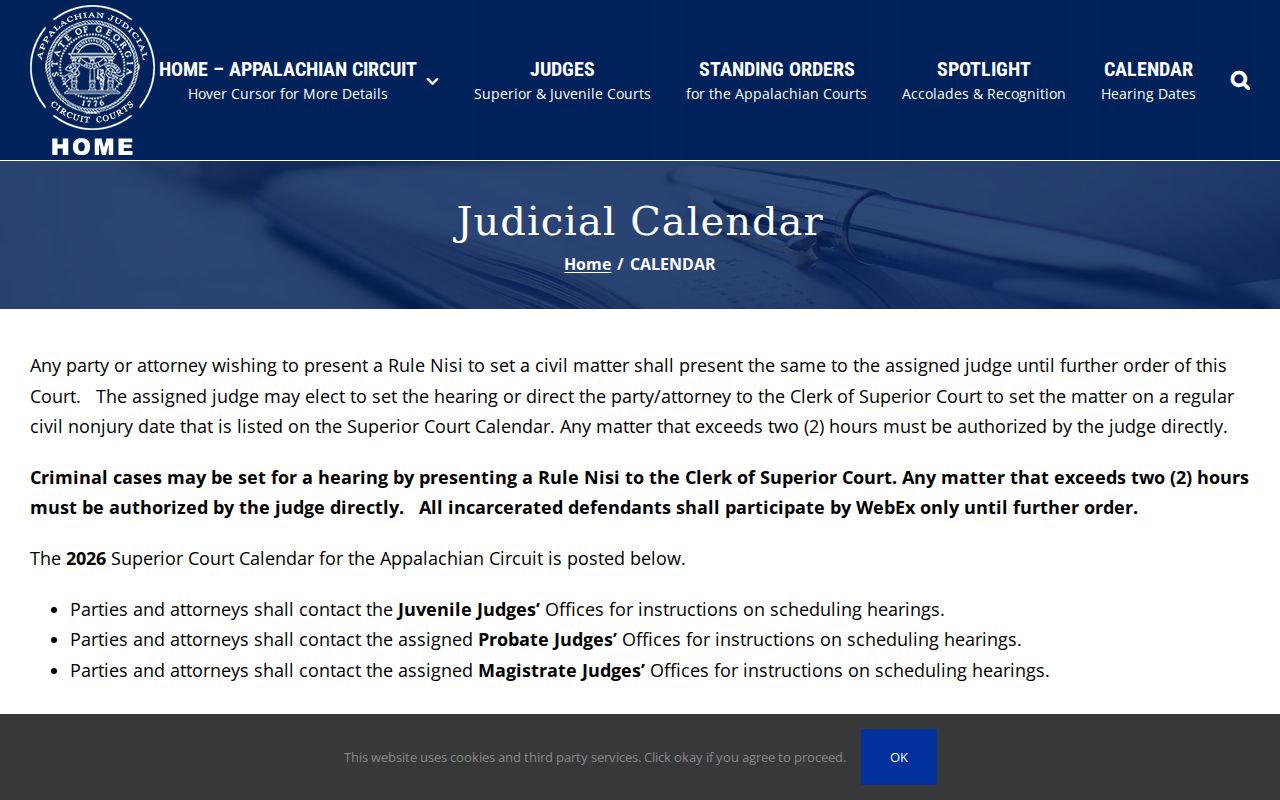
What you can reach without a provider account covers the circuit's current calendar resources. It also points scheduling questions to the proper court office. That role is narrow but real.
Download a fresh copy each time. A saved PDF can go stale fast. The yearly schedule gets revised, and emergency orders can change operations. For anything specific, a current docket entry or a direct call beats a general setting block.
How to Find Your Court Date
Pull the court name and any case or citation number off your paperwork. PeachCourt handles Superior Court material. The Georgia E-Access directory routes you there first, though it requires an account. Then check the Appalachian calendar for a public setting block. Still stuck? Call the responsible office instead of guessing from a similar label.
- Read the court name, county, and case or citation number on the notice.
- Check PeachCourt for a Superior docket or the proper city traffic portal for a citation.
- Open the current Appalachian calendar and find the G-coded setting where relevant.
- Call the clerk or assigned judge's office to confirm date, time, place, and appearance method.
- Check with counsel and review any later signed notice or emergency order.
The phone list: Superior Clerk at 706-635-4462. Judge Mary Beth Priest's Gilmer office is 706-515-2027. Magistrate is 706-635-2515, Probate is 706-635-4763, Ellijay Municipal is 706-635-4711, and East Ellijay Municipal is 706-276-3111. When a calendar or filed setting notice never gets posted, the counter and an office-specific open-records request are the fallbacks, and a courthouse posting or docket call can confirm that day's work. The county publishes no public-posting policy.
Gilmer Calendar Codes
The yearly PDF packs court, county, and setting details into short labels. The letter G marks Gilmer County. CR stands for criminal and CV for civil. The legend also lists M for misdemeanor, DC for Drug Court, REC for Help Court, and VC for Veterans Court.
- G-CR NJ
- A Gilmer criminal nonjury calendar block.
- G-CV NJ
- A Gilmer civil nonjury calendar block.
- Arraignment
- A scheduled criminal stage addressing charges and a plea.
- Mtn/Plea
- A setting for motions or plea matters.
- Prob Rev
- A probation review setting, not a final result.
None of these are case-number codes. A label proves nothing about what happened, either. Outcomes live in the case docket and the signed order.
Reading a Court Setting
Work through the fields in order. Check the date and time first, then confirm the G for Gilmer. Match the event code and setting label to the type of proceeding. Read the judge initials as the planned assignment. No courtroom, party style, attorney, or case number appears in the public PDF.
| Date | The planned month and day in the yearly calendar. |
|---|---|
| Time | The time for the listed setting block, not necessarily an individual appointment. |
| County | G identifies Gilmer within the three-county circuit. |
| Judge | Initials identify the scheduled judge; confirm any reassignment. |
| Setting type | Arraignment, nonjury, motion or plea, review, or a specialty program label. |
| Courtroom | Not visible in the inspected yearly PDF; obtain it from the court. |
Without a case number, a setting block cannot be matched from the calendar alone. Give the clerk the case details instead, or open the authenticated docket through the right provider.
Gilmer Court Calendar Confirmation
The Appalachian Circuit judges page lists the circuit's judges. It also publishes Judge Priest's Gilmer office contact.
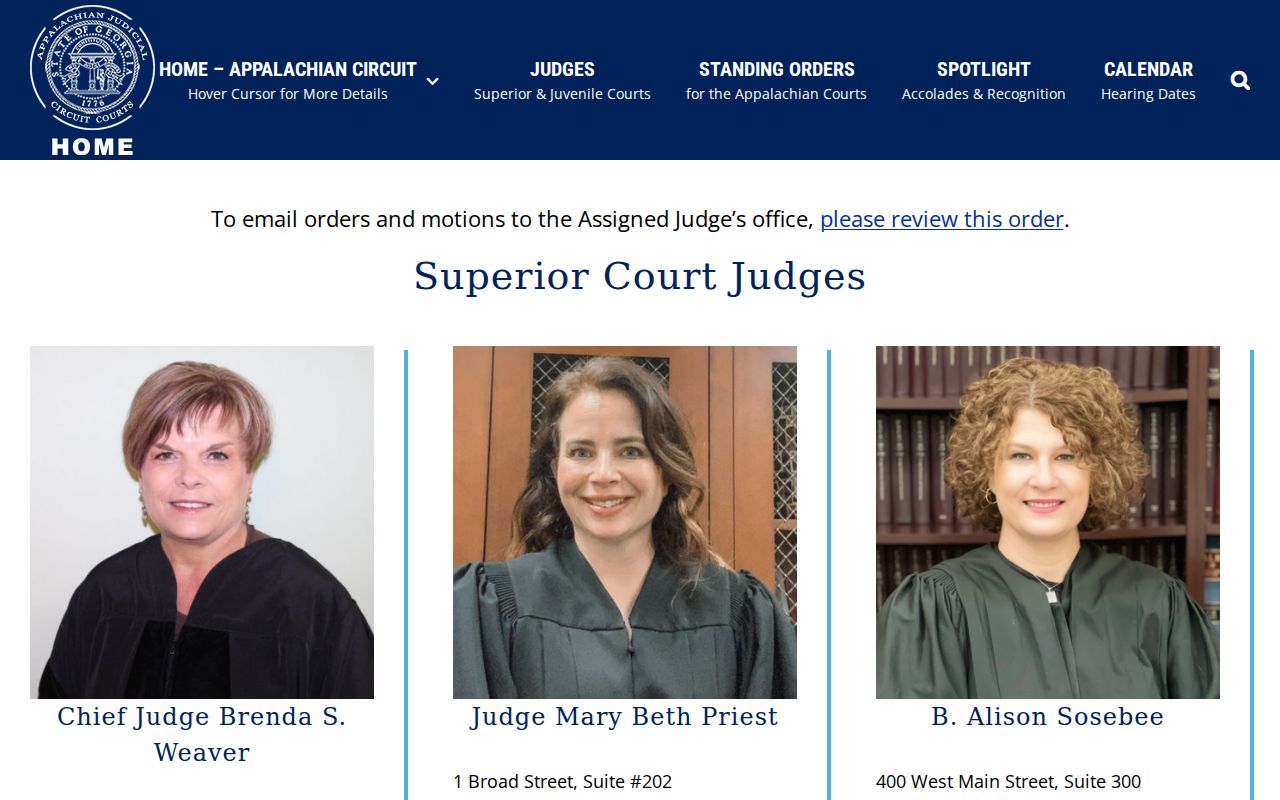
That official page backs up a key calendar fallback. A Rule Nisi, a long hearing, or a judicial assignment may call for direct action, and the judge's office and the clerk are two different doors. Use whichever one the scheduling instructions name.
County and circuit sources describe some court office locations differently. Call before you drive. When you do, confirm the date, arrival time, room or building, judge, and whether the appearance is remote or in person.
Resets, Continuances, and Cancellations
Three terms matter here. A continuance pushes a proceeding to a later time. A reset places it on another setting, and a cancellation means the listed event will not go forward as planned. No public Gilmer register tracks case-specific reset history. The annual PDF never compares an old date against a new one. A missing block proves nothing about dismissal.
Stack your sources instead. Look at the newest filed notice or the PeachCourt docket. Compare the current Appalachian calendar. Then call the clerk, the assigned judge's office, or counsel. An unposted filed notice can be requested through county or city open records. Never read a new date out of another case or a recurring calendar pattern.
Emergency orders change things too. A September 2024 order closed the Gilmer courthouse. It extended filings during Hurricane Helene. A January 2026 winter order canceled court classes and pushed deadlines back. Both carried dates and fit specific events, so current official instructions always control.
Gilmer Civil Scheduling Rules
Scheduling in Gilmer County runs on distinct tracks. A civil Rule Nisi goes to the assigned judge. That judge either sets the hearing or sends the party or attorney to the Superior Clerk for a regular civil nonjury date on the calendar. Expect a civil matter to run past two hours? It needs direct authorization from the judge. Criminal hearings work a bit differently: you present the Rule Nisi to the Superior Clerk, and anything over two hours still needs a judge's sign-off. Juvenile, Probate, and Magistrate settings each come from their own offices. One blanket calendar request simply cannot cover every Gilmer County court date, and that is why the circuit publishes these directions separately.
Some appearances happen by video. Incarcerated defendants participate by WebEx until further order, and the calendar page carries remote-hearing links for Superior and Juvenile. One caution applies. A remote link does not itself establish that a particular party may appear online, so confirm the method stated for the case.
Gilmer Municipal Court Calendars
Ellijay posts its own 2026 Municipal Court schedule. Sessions land on the third Tuesday of each month at 5:00 p.m. They start January 20 and end December 15. Keep in mind that pattern belongs to Ellijay Municipal Court alone, not to Superior, Probate, Magistrate, or East Ellijay. Check the date printed on your citation first. Call the city clerk if it conflicts with the posted list.
East Ellijay takes a different approach. Its official Municipal Court page lists location, hours, case scope, and a payment route. It offers no public court-date list or calendar search. For a hearing date, call 706-276-3111 with the citation in hand. Remember that a payment portal is not a hearing calendar. City matters stay with the city clerk unless a later filing or a confirmed appeal moves them elsewhere.
City calendar check: Identify the issuing city before using a recurring date pattern or payment page.
What To Do If You Miss a Setting
Reach out to the responsible court or your counsel right away. Have the case or citation number, the missed date, and the kind of setting ready. Ask whether a new date has been entered. Ask what filing or appearance is now required. Paying, calling, or showing up at a different court does not fix a missed setting. Do not assume it will.
Missed a setting? A missed criminal or traffic appearance can lead to a failure-to-appear action, warrant, or bond consequence.
Call the correct clerk promptly and consult a licensed attorney about the case before appearing without confirmed instructions.
Miss a civil setting and the court has options. Depending on the case and the notice given, it may proceed, postpone, dismiss, or enter some other order. The public yearly calendar cannot tell you which happened. Review the filed docket and get the signed order, since that document answers the question. A Gilmer County case search can help you locate the register. The clerk's office confirms the official record.
Gilmer Court Date Cross-Checks
No single source should stand alone when you check a Gilmer County court date. The annual calendar lays out planned blocks for the whole Appalachian Judicial Circuit. PeachCourt may list a Superior entry for one case after you log in. A filed notice or signed order beats them all for that case. The clerk can confirm a change. So can the assigned judge's office or your lawyer. Start with the source that is both most specific and most current.
Before you call, write the setting down in full. That means court, case or citation number, party name, date, time, label, judge initials. It also includes any remote-hearing note. Ask whether the time is a docket-call time or a single appointment. Ask for the room and building too. The public PDF does not list courtroom fields. County and circuit sources describe addresses in conflicting ways. A quick phone check is wise. Do that before you drive anywhere.
When no notice has been posted, ask the right office for the filed setting document. Superior questions go to the Superior Clerk or the assigned judge's office. Magistrate and Probate each keep their own records. City citations stay with Ellijay or East Ellijay. County and city open-records channels can help with public material. They are not reminder services. They cannot override a court's scheduling order.
Keep a note of each confirmation and its source. Then recheck close to the appearance date, above all during severe weather. Do that again after a continuance request too. The 2024 hurricane and 2026 winter orders prove Gilmer court operations can shift through formal emergency action. A fresh official notice always controls over an old PDF or a saved copy. It also beats any assumed monthly pattern.