
How to Get Court Records
Begin with whatever court is named on your paperwork. Amy E. Johnson, Clerk of Superior Court, holds Gilmer Superior and Juvenile records. Those cover criminal, civil, juvenile, and jury files. Probate Court keeps probate files plus county traffic matters. Magistrate Court handles its civil claims, dispossessory, ordinance, warrant, and preliminary-hearing docket. The Ellijay and East Ellijay clerks keep their own municipal records. A broad request sent to the wrong office just adds delay.
For Superior Court dockets and documents, start at the Georgia Courts E-Access directory. It sends Gilmer Superior users to PeachCourt. An account is required there. If the file is old, the image is missing, or you need a certified copy, call the clerk. You can also visit the counter. County-held material can also go through the office-specific written open-records route. The clerk's office publishes no general court-copy mail form. Nor does it post a public-terminal policy or universal email request method.
- Identify the court, case number, names, and date range.
- Choose a docket sheet, named document, transcript, or certified copy.
- Check PeachCourt for an available Superior document.
- Call or visit the separate Probate, Magistrate, or city custodian.
- Use the county written request route when a county record is not online.
- Confirm the current charge, payment method, and delivery before ordering.
Gilmer County Court Records Requests
For county-held material, the county Open Records Request page is the clearest published route. It sorts requests by office. It lists clerk-related categories such as divorces, criminal records, deeds, liens, plats, surveys, passports, covenants, and notary records. Court and land-record functions share that list. So name the exact court file or document you need rather than asking for "all records." The Gilmer County Open Records Request page posts the local fee and timing guidance.
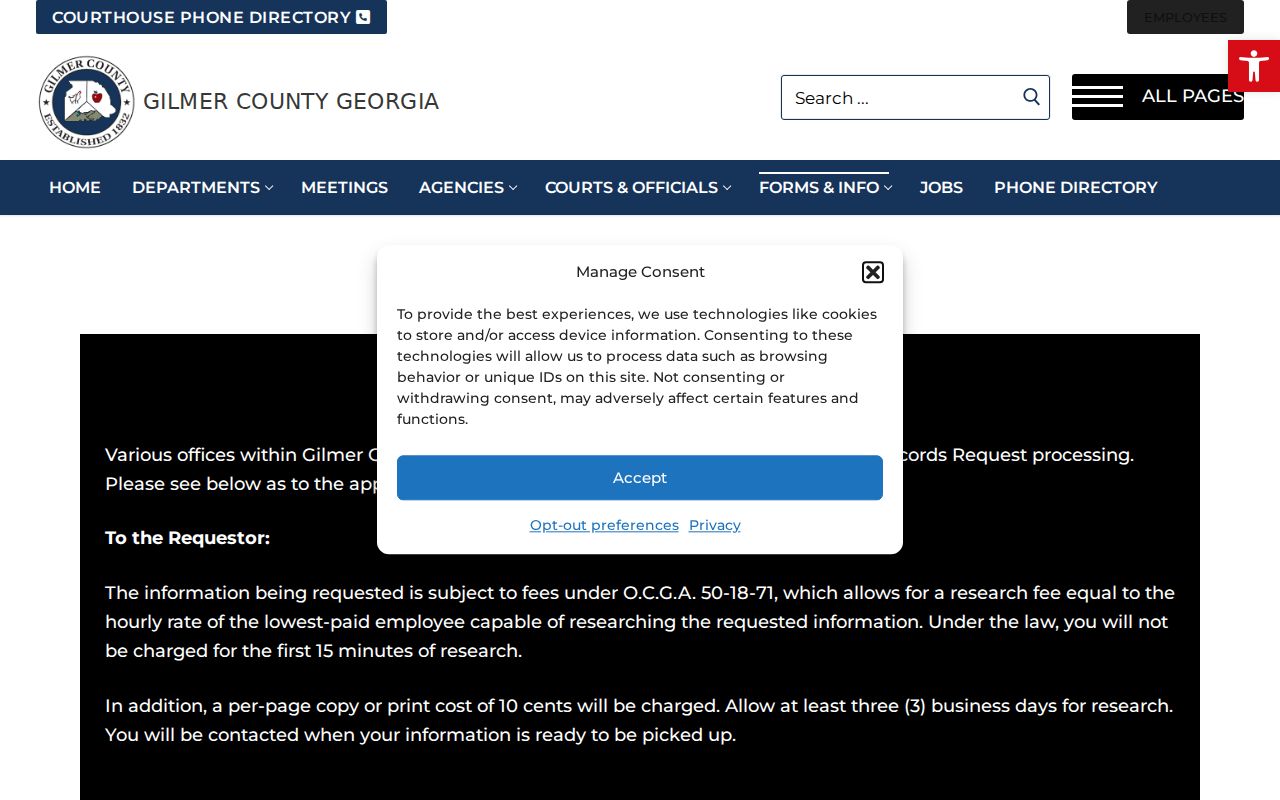
Gilmer County's fee rules for court records requests are simple. The first fifteen minutes of searching cost nothing. After that, the county may bill at the hourly rate of the lowest-paid employee who can handle the work. Copies or prints run $0.10 per page.
Give the clerk at least three business days before asking about pickup. Even then, that window is not a guarantee. Pulling a court file can take extra time. Legal review, restricted material, and certification can each add more of their own to a records request.
Types of Gilmer County Court Records
A Gilmer County docket is a chronological index, not the whole case file. Each motion or order listed may point to a separate document. The filed paper is the real thing. It is the pleading, return, motion, exhibit, judgment, or signed order behind an entry. A certified copy carries the clerk's authentication for formal use. Transcripts work differently. They come through the court reporter, not as an ordinary clerk document.
- Docket sheets and chronological case entries
- Complaints, petitions, answers, motions, and returns
- Notices of settings, signed orders, judgments, and dispositions
- Public exhibits and attachments when available
- Plain copies and clerk-certified copies
- Separately ordered hearing or trial transcripts
Ask for one category at a time. PeachCourt may sell an available document image. Only the responsible clerk decides whether a copy is official, though. Old exhibits can still need physical retrieval even when the case index is electronic. And a city record must be requested from that city. It never becomes part of the county clerk's file.
Gilmer County Court Record Choices
Each product answers a different need. A docket traces when filings and settings happened; a document shows the substance of one filing; a certified copy proves the clerk authenticated the reproduced record. Mixing them up can leave you with an incomplete order or an avoidable fee.
| Record | Best use | Likely source |
|---|---|---|
| Docket sheet | Follow filing and setting history | PeachCourt or responsible clerk |
| Filed document | Read a pleading, order, or judgment | Provider image or clerk file |
| Certified copy | Obtain clerk authentication | Issuing court clerk |
| Transcript | Read spoken proceedings | Court reporter |
Never label a portal printout as certified. Ask instead whether certification exists for your document, what the current fee is, and whether payment must arrive first. No Gilmer court publishes a complete certified-copy fee table covering every court.
What a Gilmer Court Record Contains
What a file contains depends on several things. The court, the case type, account access, and restriction status all matter. A typical public file identifies the case, the parties or their roles, the filing history, hearing notices, court orders, and disposition. It may add financial entries or public exhibits. The open Appalachian calendar is narrower. It lists dates, times, Gilmer's "G" county code, setting labels, and judge initials. But it leaves out the party style, case number, courtroom, and any linked document.
| Case number | The court's unique identifier, when publicly available. |
|---|---|
| Caption | The formal case style and party roles. |
| Pleadings | Petitions, complaints, answers, motions, and responses. |
| Settings | Notices and docket entries for hearings or trials. |
| Orders | Signed directions, rulings, judgments, and dispositions. |
| Exhibits | Filed attachments where public and retained. |
Protected identifiers may be masked, and a sealed entry may vanish or show only limited metadata. A missing online image does not prove the paper file is gone.
Gilmer County Court Records Online
Georgia Courts names PeachCourt as mandatory for e-filing in Gilmer Superior Court. PeachCourt also offers account-based purchase of available documents. Its guidance lists $0.50 per page plus a small convenience fee. Date coverage varies by court and system. Sealed, adoption, and proposed but unexecuted documents are excluded. The provider page makes no promise of a free, no-login Gilmer register.
If PeachCourt lacks the image you want, write down the docket description, filing date, and case number. Then ask Amy Johnson's office whether the document can be inspected or copied. A vendor's blank screen proves nothing about access. The file could predate electronic coverage or sit in offsite storage. It might belong to another court. It might simply need staff retrieval.
Portal gap: an unavailable download is not a final access ruling. The originating clerk can identify whether the paper exists and what request route applies.
Certified Copies and Fees
Copy charges in Gilmer County come from more than one office. Treat each fee on its own terms. The county's general open-records page lists its copy and research charges. PeachCourt sets its own price for documents. Ellijay's older 2016 schedule lists city amounts that should be confirmed before you rely on them. East Ellijay publishes no current document-copy fee. Traffic fines, meanwhile, are what you owe on the case itself. That is not the price of a copy.
| Source | Published amount | Caution |
|---|---|---|
| Gilmer County request | $0.10 per page | General county copy guidance |
| County research | First 15 minutes free | Later time uses the statutory labor rule |
| PeachCourt document | $0.50 per page plus convenience fee | Account and coverage limits apply |
| Ellijay certified copy | $10 in the 2016 schedule | Verify the dated city amount |
| East Ellijay copy | Not published | Request a current quote |
Clerk of Superior Court
1 Broad Street, Suite 203
Ellijay, GA 30540
706-635-4462
The official pages disagree about the suite number, so call the office before you go. Ask whether the clerk takes your planned payment type and whether the request must be mailed or made at the counter.
Gilmer County Federal Court Records
Federal cases do not run through the Georgia clerk system. Gilmer County sits in the Gainesville Division. That division belongs to the U.S. District Court for the Northern District of Georgia. Federal docket sheets and filings live in PACER and CM/ECF. A federal case number looks like 1:26-cv-04374-TRJ-RGV. Never apply that federal format to a state case. The Northern District CM/ECF information page lays out federal filing and docket details.
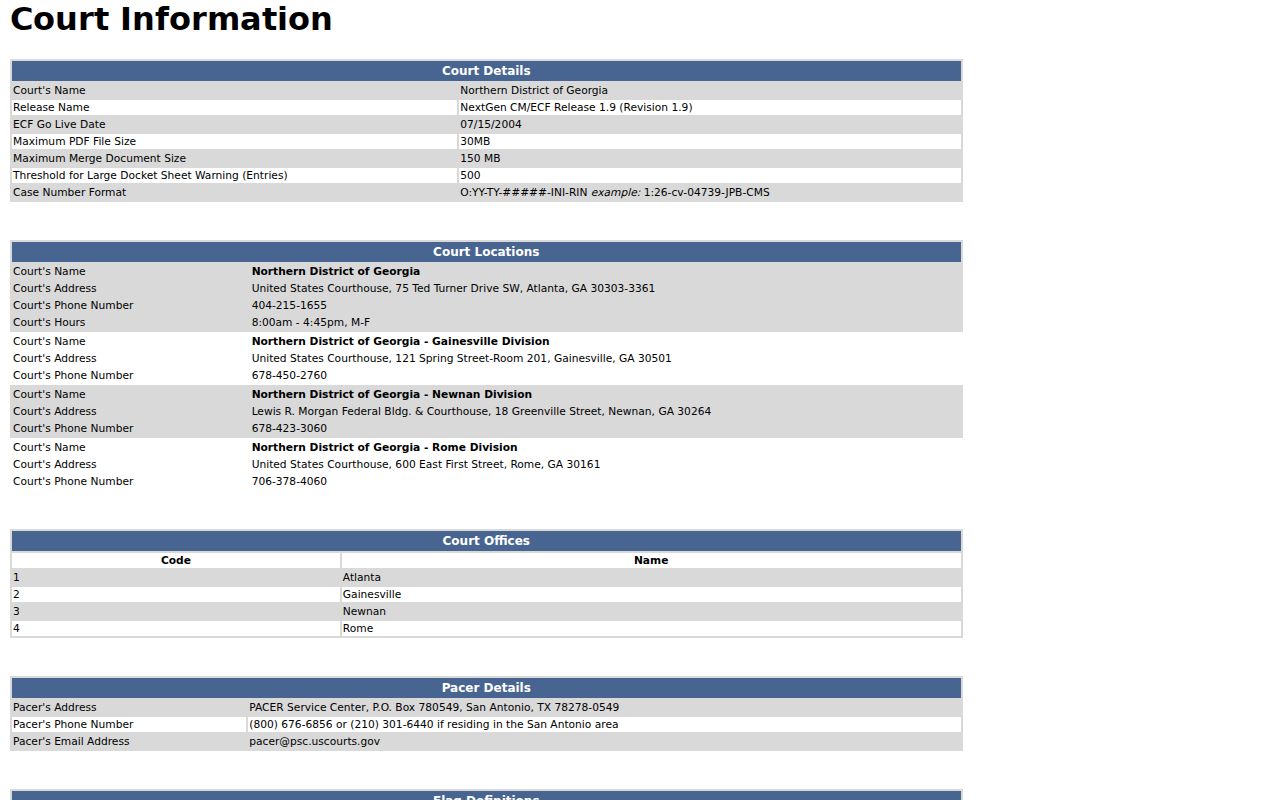
That federal page belongs to a separate custodian with its own numbering and access system. PACER rates and federal courthouse rules govern, not Gilmer County copy terms. The Bankruptcy Court Rome location page gives you a counter reference.
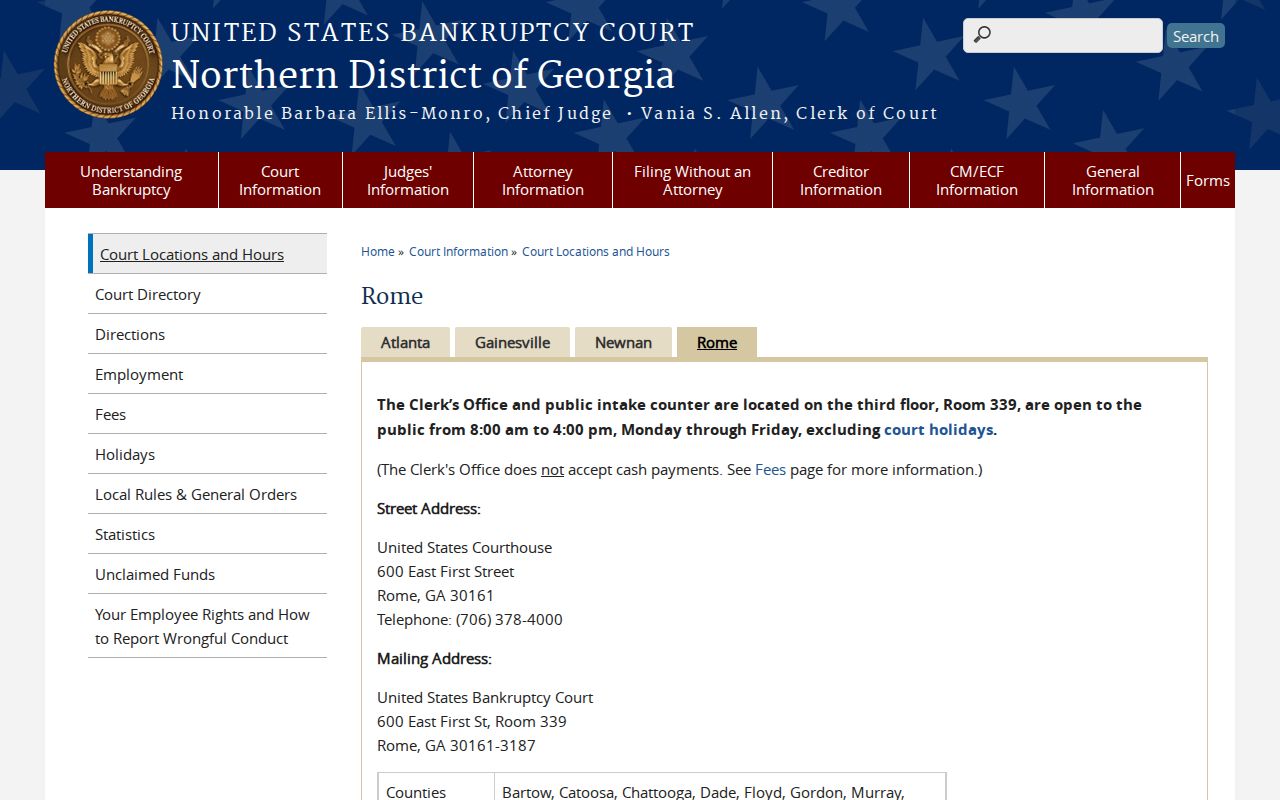
Rome's published county list does not prove it is Gilmer County's assigned bankruptcy division. Check PACER or ask the bankruptcy clerk rather than trusting location alone.
Gilmer County Transcript Requests
A transcript is not the clerk's docket or a filed order. It is the written record of what was said in court. You normally order it from the court reporter or the reporter's office. Gilmer County posts no current transcript rate, order form, deposit rule, or delivery schedule. Ask directly. Before you inquire, know the court, the case number, the hearing date, the judge, and the type of proceeding. That tells you which reporter covered it. Use the docket or the clerk to pin down the date first. Then get a quote from the reporter. Do not ask the clerk to certify a portal image as a transcript. Do not apply PeachCourt's document price to reporter work.
Public Access and Sealed Records
Uniform Superior Court Rule 21 sets the framework for Superior Court access and restriction. Rule 21.6 covers protection of personal identifiers. The Georgia Open Records Act, O.C.G.A. §50-18-71 governs inspection, copying, timing, and search costs for covered public records. Magistrate Court keeps its own docket under Uniform Magistrate Court Rule 5. Sensitive information is protected under Rule 20.
Juvenile records run on a controlled access system. Sealed portions, adoption records, and protected identifiers are not ordinary public downloads. A party may open doors the public cannot. So may an authorized attorney, a law-enforcement request, or a court order. If a record will not come up, confirm the court and the case number first. Then ask whether it is sealed, restricted, juvenile, not digitized, or held by a different custodian.
Access rule: the public docket is a finding aid, while the responsible clerk determines access to the original record and issues certified copies.