
How to Search Criminal Dockets
Check the paperwork first. The notice, bond paper, citation, or prior order usually names the court you need. The Georgia Judicial Gateway E-Access directory lists Gilmer Superior Court and points to PeachCourt. Treat it as a directory rather than one statewide case database. Georgia Courts notes that the provider requires an account. The public PeachCourt screen offers only email, password, registration, and login controls. It promises nothing about local name-search rules or case-number format.
The docket you need may not appear. In that case, call the Superior Court Clerk at 706-635-4462 or go to the counter. Probate takes 706-635-4763 and Magistrate 706-635-2515 if either of those courts holds the matter. For city tickets, Ellijay Municipal Court uses 706-635-4711 and East Ellijay uses 706-276-3111. Ask whether inspection, a plain copy, or certification fits your need. The courts publish no criminal-specific mail route or public-terminal policy. Confirm either option before you send anything.
Gilmer Criminal Court Routing
Many searches fail because they begin in the wrong venue. Felonies and major proceedings belong to Gilmer County Superior Court. That court is part of the Appalachian Judicial Circuit. Magistrate Court covers warrants, preliminary matters, county ordinances, and certain minor work. County traffic cases run through Probate Court. That court can also hear certain misdemeanors when no jury is requested. Ellijay and East Ellijay each keep their own municipal citations.
| Court | Scope | Access |
|---|---|---|
| Superior | Felonies and major proceedings | PeachCourt or clerk |
| Magistrate | Warrants, preliminaries, ordinances | Magistrate office |
| Probate | County traffic, some misdemeanors | Probate office |
| Municipal | City citations | Issuing city clerk |
Gilmer County has no State Court. Do not route a case there just because another Georgia county operates one.
What a Criminal Docket Shows
Think of the docket as a dated index of court activity. A full register may identify the case, list filings, note hearings, show orders, and record a plea, trial, sentence, appeal, or probation action. The public Appalachian calendar is narrower. It lists dates, times, a county letter, setting labels, and judge initials, but no names, case numbers, charges, bond amounts, dispositions, or documents.
- Identity
- Case number and caption when the clerk register exposes them.
- Filings
- Charging papers, motions, notices, and signed orders.
- Settings
- Arraignment, plea, nonjury, trial, or review dates.
- Outcome
- Plea, dismissal, judgment, sentence, or appeal when confirmed.
- Images
- Available through PeachCourt or a custodian request.
A calendar line is not a result. It tells you when a class of matters may be heard, not what happened in any one case.
Reading Gilmer Criminal Codes
The official calendar relies on compact labels. In Gilmer, G means the county and CR means criminal. Expect entries like G-CR NJ, G-Arraignment, G-Mtn/Plea, and G-Prob Rev. These are setting labels only. They are never case numbers or dispositions.
- CR NJ
- Criminal nonjury setting.
- Arraignment
- A stage when charges and a plea are addressed.
- Mtn/Plea
- A block for motions or pleas.
- Prob Rev
- A probation review setting, not proof of an outcome.
- VC, DC, REC
- Veterans Court, Drug Court, and Help Court labels.
Gilmer publishes no full list of disposition codes. Terms like dismissal, conviction, and forfeiture call for confirmation from the actual docket or the clerk.
Stages on a Criminal Docket
A Superior Court docket often opens with a charging document. Arraignment and bond activity follow, then motions and notices. From there the case resolves by plea or moves to trial, with disposition and sentence coming later. After judgment, probation, forfeiture, or appeal entries may appear.
Filing → Arraignment → Pretrial → Plea or Trial → Disposition → Sentencing
Read entries by date and type. A motion is a request, not a ruling, and a setting does not prove the hearing occurred. Verify any sentence against the signed judgment. The county case search routes can help locate a file before you request documents.
PeachCourt Gilmer Criminal Dockets
PeachCourt serves as the mandatory e-filing provider for Gilmer Superior Court. It is also the provider named through Georgia E-Access. Its own guidance says coverage varies, reaching back about 2005 in participating systems. Available documents cost $0.50 per page plus a small convenience fee. Sealed records, adoption records, and proposed or unexecuted material stay excluded. No docket-view price appears before login.
The Appalachian Circuit standing-order index gathers rules on bond, e-filing, recording, emergencies, and access.
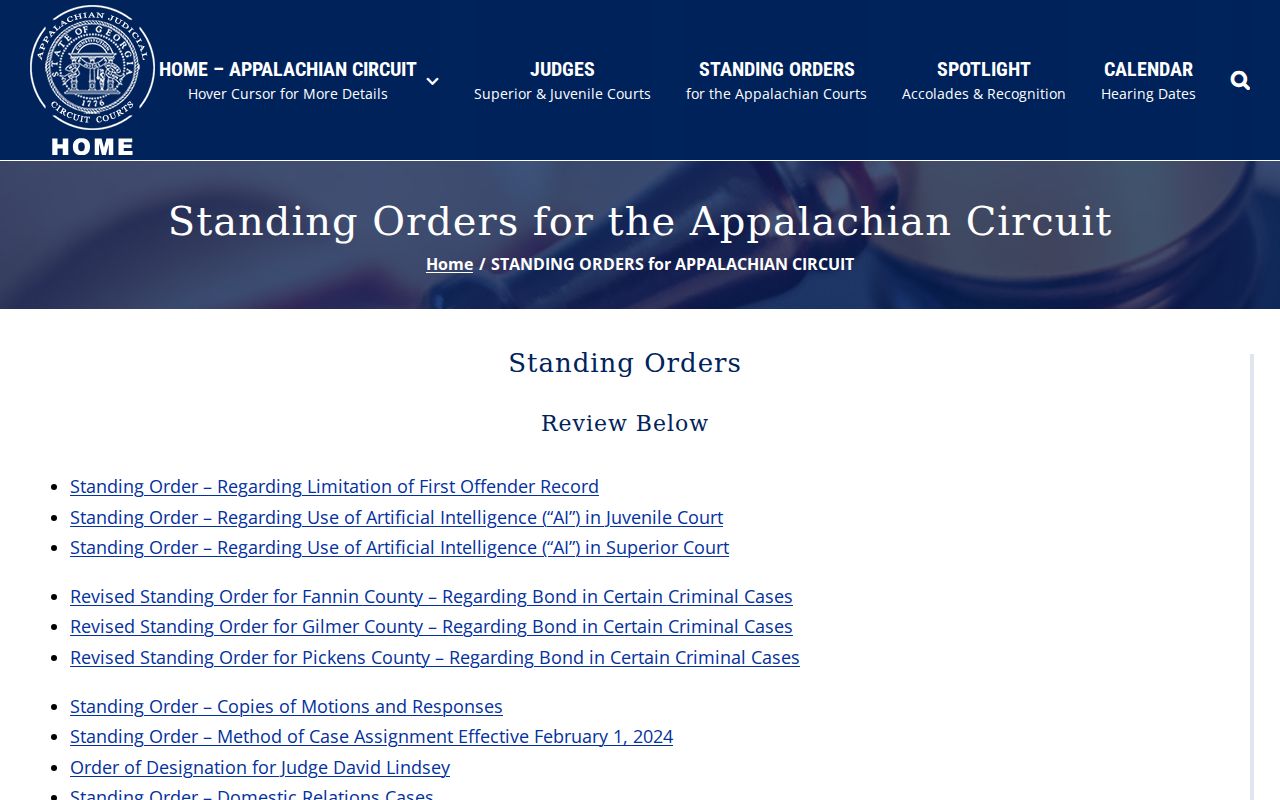
That index matters. A current standing order can change procedure even when the yearly public calendar looks the same.
Which Court Holds Criminal Dockets
Amy E. Johnson is the Clerk of Superior Court. She is the published custodian for Superior and Juvenile records. Juvenile information is controlled. It is not an ordinary public criminal search. Probate and Magistrate keep separate records. City clerks keep municipal citations. No office can certify another court's file.
Use PeachCourt for online Superior material and the Appalachian calendar for public settings. For an old, missing, or certified record, contact the right counter directly. The county open-records route covers non-online material. It advises allowing at least three business days for research. It cannot override a seal, juvenile limits, or a court order.
Missing Gilmer Criminal Cases
An absent result does not mean no case exists. Check the spelling, county, date, and court. Then ask whether Probate, Magistrate, Juvenile, Ellijay, or East Ellijay holds the file, since it may predate online coverage, sit only at the counter, or be restricted.
Practical next step: Give the clerk the court name, known case or citation number, approximate date, and the exact setting or document needed.
For a current appearance, confirm the date with the court or counsel. Emergency orders, remote-hearing directions, and later settings can supersede a planning calendar.
Public Access and Sealed Criminal Dockets
Uniform Superior Court Rule 21 opens Superior Court records to the public. It also sets procedures for restriction. And it protects certain identifiers. Georgia juvenile law stands apart as its own controlled system. PeachCourt, for its part, leaves sealed and adoption documents out of its document service entirely.
So a docket search can end several ways. You might get a full register. Or partial data, a restricted marker, or nothing online at all. Redacted identifiers are routine, not a red flag. Even so, a Gilmer County court docket can locate a filing. It can confirm a date, follow a public proceeding, or support local history research. Want a certified copy? Only the custodian of the original record can provide certification.
Gilmer Criminal Calendar Limits
The Appalachian Judicial Calendar is the best no-login source for Superior Court settings. Its purpose is narrow. Entries run by date and setting block. There is no public search by name, attorney, or case number. Find the Gilmer county letter and criminal code. Then compare the date, time, label, and judge initials. That can tell you when a Gilmer County criminal docket call is planned. It cannot break the block down case by case.
This gap matters most after a reset. The yearly PDF gives no case-specific history of old and new dates. So start with the paper notice or an authenticated docket. Check it against the current circuit calendar. Then contact the clerk or your attorney. The circuit also posts remote-hearing links; incarcerated defendants appear by WebEx until further order. Weather orders have closed the Gilmer courthouse and extended deadlines before. A dated emergency order always controls over an older calendar copy. So does direct confirmation from the court.
When you call for confirmation, name the court and the type of setting. Arraignment, motion or plea, criminal nonjury, and probation review are different pieces of calendar work. Give the case number if you have it, plus the party name and approximate date. Those details matter. They let the custodian tell a general setting block apart from the underlying Gilmer County criminal court docket.
Gilmer Criminal Record Requests
Know exactly what you are asking the clerk for. Three products get mixed up constantly. Calendar information names a hearing block on a schedule. A docket register lists dated entries showing what happened in a case. A filed document is the actual text of a charge, motion, order, or judgment. So name the product you need. Asking for the "whole case" means far more digging and copying. It costs more than asking for one signed order.
For Superior Court material, give Amy Johnson's office the court. Include the case number if you have it. Add the party name, the approximate year, and the document title. Ask whether the file can be inspected. Ask whether a plain copy exists. Ask what certification would cost. The clerk posts no criminal-specific mail, fax, dropbox, identification list, or certified-copy price schedule. Confirm those details before sending payment or personal data. Also note that PeachCourt's document charge says nothing about the clerk's certification charge.
The county open-records page offers another route, office by office. It sets the first 15 minutes free. It prices ordinary copies at $0.10 per page. And it asks for at least three business days before records are ready. Those terms cannot unseal a sealed record, lift juvenile confidentiality, or expose protected personal information. Nor does the county promise that every court document comes out through a general request. The court itself decides the proper access procedure.
For Probate, Magistrate, or municipal records, address your request to that court, not the Superior Clerk. Include the issuing court named on the citation or notice. If certification matters, ask which office can authenticate the original. That habit pays off. It keeps a Gilmer County criminal docket request pointed at the office that created and maintains the record.